Your Weekly Insider Trading Intelligence: What Corporate Executives Are Buying and Selling (And What It Means for Retail Traders)
Weekly Insider Activity Report
Foxpoint Market Intelligence Staff
12/29/202512 min read
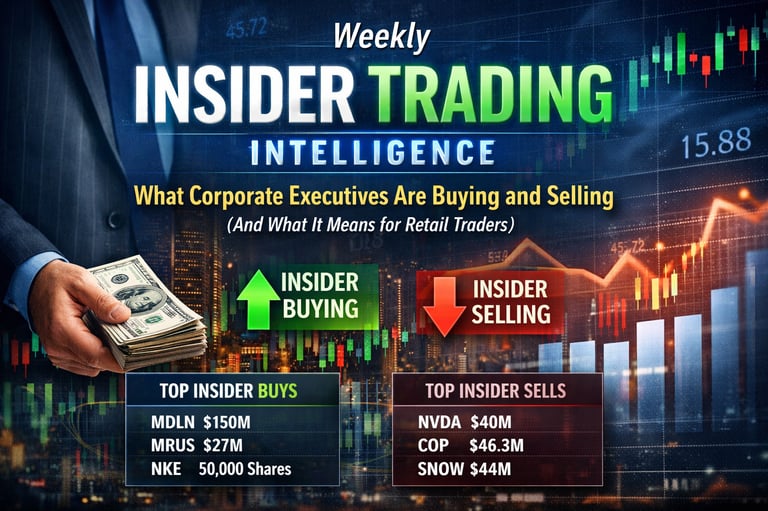
Introduction: Insider trading activity – in the legal, above-board sense – refers to corporate executives, directors, and major shareholders buying or selling stock in their own companies and reporting those trades to the SEC via Form 4 filingsnasdaq.com. Unlike illegal insider trading (trading on non-public information), these transactions are disclosed to the public within days and can offer powerful stock market signals. There’s a famous adage from investor Peter Lynch: insiders might sell shares for many reasons (diversification, taxes, etc.), but they buy shares for only one – they believe the price will risenasdaq.com. In other words, when top executives put their own money on the line, they’re “putting their money where their mouth is” to signal confidencebusinessinsider.com. Savvy retail traders track this insider buying and insider selling data as part of their retail trader strategies, looking for clues about a company’s prospects. Over the last 10 trading days, a flurry of insider trades by corporate leaders has provided fresh insight into which sectors insiders are bullish on and where they’re cashing out.
Weekly Insider Trading Summary (Past 10 Days):
Technology: This week, tech insiders largely sold rather than bought. After a year of big gains in tech stocks, multiple executives took profits. For example, Nvidia (NVDA) director Mark A. Stevens sold 222,500 shares (~$40 million worth) in the open marketinsider-monitor.com. Likewise, Broadcom (AVGO)’s CEO, Hock Tan, offloaded 130,000 shares for about $42.4 millioninsider-monitor.com. Cloud-computing firms saw similar moves: Snowflake (SNOW) CEO Frank Slootman sold 200,000 shares (~$44 million) amid the stock’s strengthinsider-monitor.com. By contrast, notable insider buying in tech was scarce – no major Silicon Valley CEOs or CFOs made large open-market purchases in the last two weeks. The overwhelming selling suggests tech executives are locking in gains, a potential caution sign that they view current valuations as rich or are timing year-end portfolio adjustments.
Healthcare & Biotech: Insider activity in healthcare skewed bullish. In one of the largest insider buys of the year, executives at medical supplier Medline Inc. (MDLN) snapped up enormous stakes: company leaders (the Mills family) purchased roughly $150 million in stock, and a related insider investor (Hux Investment) bought about $365 million worthinsider-monitor.cominsider-monitor.com. These staggering buys – over $500 million in total – signal a strong vote of confidence in Medline’s prospects. In biotech, Merus N.V. (MRUS) saw its development partner Genmab A/S invest heavily, buying roughly $27 million of Merus shares over two daysinsider-monitor.com. On the selling side, there were only moderate sales in healthcare: for instance, Mirum Pharmaceuticals (MIRM)’s CEO sold about $3.9 million worth of stockinsider-monitor.com, and a handful of insiders at Arrowhead Pharmaceuticals (ARWR) collectively sold small portions (several hundred thousand dollars each) after a recent stock uptickinsider-monitor.com. The outsized buying in this sector – particularly by insiders with industry expertise – suggests that healthcare executives see value and potential upside in their companies’ shares, even as a few are trimming positions after rallies.
Finance & Insurance: In the financial sector, insider signals were mixed but leaned positive. Notably, property-casualty insurer W.R. Berkley (WRB) had a major insider purchase: MS&AD Insurance Group (a 10% strategic owner) bought about $42.5 million of WRB stock in three daysinsider-monitor.com. Such a significant add-on by an insider stakeholder underscores confidence in the insurance industry’s outlook. Meanwhile, several small-cap financial companies experienced cluster buying, where multiple executives bought shares simultaneously – a classic bullish indicator. For example, at mortgage REIT Bimini Capital Management (BMNM), the CEO, CFO, and two directors all purchased shares around $1.55, each spending roughly $75k–$300kinsider-monitor.com. Similarly, at TriplePoint Venture Growth (TPVG), both the CEO (James Labe) and President/CIO (Sajal Srivastava) bought ~25–29k shares each (around $160–$180k per insider) on the same daysinsider-monitor.com. These coordinated buys suggest insiders collectively believe their stock is undervaluednasdaq.com. On the other hand, there were a few notable sales in finance: Arthur J. Gallagher & Co. (AJG), a global insurance broker, saw its General Counsel exercise options and sell shares worth about $4 millioninsider-monitor.com. By and large, though, financial insiders were not heavy sellers in the last 10 days – the absence of big selling (and presence of cluster buying) implies a generally positive insider outlook in this sector.
Consumer (Retail & Discretionary): In consumer-facing companies, insider trades sent divergent messages. Athletic apparel giant Nike (NKE) received a high-profile vote of confidence from its board: Apple CEO Tim Cook, a longtime Nike director, made a rare personal stock purchase, buying 50,000 shares of Nike (~$2.95 million)reuters.com. This move nearly doubled Cook’s stake and “signaled confidence” in Nike’s turnaround planreuters.com. The news broke just before Christmas and Nike’s stock jumped ~4.6% after the filing became publicreuters.com, suggesting that the market views insider buying by a respected executive as a bullish signal. Fellow Nike director and former Intel CEO Robert Swan also bought ~$500,000 of Nike stockreuters.com, making these the largest insider buys at Nike in over a decade. We also saw insider buying in leisure products: at MasterCraft Boat Holdings (MCFT), board member Adam Gray accumulated roughly 134,000 shares over a few days (~$2.65 million total) as the boat maker’s stock traded in the high-teensinsider-monitor.com. In contrast, insider selling was pronounced at some consumer companies. Revolve Group (RVLV), an e-commerce fashion retailer, had both of its co-CEOs unloading stock in tandem – Michael Karanikolas and Mike Mente each sold large blocks of shares, roughly $6–7 million apiece over the past weekinsider-monitor.cominsider-monitor.com. Such synchronized selling by co-founders raises eyebrows, as it may indicate the duo is capitalizing on share price strength or tempering expectations. Likewise, at Urban Outfitters (URBN), the husband-and-wife team of CEO Richard Hayne and CCO Margaret Hayne sold about 40,000 shares each (approximately $1.6 million each) just after the retailer’s stock hit a 52-week highinsider-monitor.com. These mixed insider signals in consumer stocks – big buys at Nike versus notable selling at fashion retailers – likely reflect company-specific situations (confidence in a turnaround at Nike, versus profit-taking after rallies in other retail names).
Energy & Industrials: Insider behavior in the energy and industrial space leaned toward profit-taking. Oil & gas executives, in particular, seem to be locking in gains after this year’s energy price strength. The most notable was ConocoPhillips (COP) Chairman and CEO Ryan Lance, who exercised stock options and sold 500,708 shares at ~$92.50, netting about $46.3 millionmarketscreener.com. This sizable sale, disclosed just before year-end, was part of a planned trading program (Form 144) accompanying his option exercise – a reminder that insider sales can often be pre-scheduled for liquidity or tax reasons. In the clean energy arena, Oklo Inc. (OKLO) – a nuclear technology startup that recently went public – saw both its co-founders dramatically reduce their stakes. CEO Jacob DeWitte and COO Caroline Cochran each sold 840,000 shares at ~$83.16, roughly $69.8 million each, according to their SEC filingsinsider-monitor.com. These unusually large sales came after a sharp rise in Oklo’s stock (likely following a successful SPAC merger), and they suggest insiders took the opportunity to realize gains. Among industrial-tech names, Intuitive Machines (LUNR), a space/NASA contractor, had its CEO Stephen Altemus sell ~1.96 million shares at ~$15.96 (about $31.3 million) as part of a block saleinsider-monitor.com – perhaps to raise capital or because the stock’s post-merger lockup expired. Not all insiders in this sector were selling, though. In precious metals, Hycroft Mining (HYMC) – known for its gold and silver mine – actually saw insider buying: a corporate insider (2176423 Ontario Ltd.) scooped up 150,000 shares at $16.31 (around $2.45 million)insider-monitor.com, even as gold prices fluctuated. This kind of contrarian buy in a beaten-down mining stock could indicate insider belief in a commodity rebound or a company-specific catalyst. Overall, energy and industrial insiders showed a pattern of major sales (likely for prudent profit-taking) punctuated by a few opportunistic buys in niche areas.
Key Takeaways: The past two weeks of insider trading data reveal several key trends and signals for investors:
Tech Insiders Are Taking Profits: The wave of insider selling in big-tech and high-valuation names is hard to ignore. When multiple executives at leading tech firms unload tens of millions in stock – as seen with Broadcom, Nvidia, Snowflake, and others – it suggests that insiders see current prices as at least fully valuedinsider-monitor.cominsider-monitor.com. Some sales were likely pre-planned, but the sheer scale (e.g. ~$40–$44 million by single insiders) points to a broader theme: after 2025’s massive tech rally, even true believers are happy to realize gains. Retail traders should view aggressive insider selling in tech as a yellow flag; while not a trigger to panic sell, it’s a signal to stay disciplined. If you’ve ridden the wave in tech stocks, consider tightening stop-losses or taking some profits. Insiders’ timing isn’t always perfect, but as one market maxim puts it, they sell for many reasons – one common reason now is arguably rich valuations.
Huge Insider Buys Signal Selective Confidence: On the bullish side, when insiders do buy big, it’s worth paying attention. We saw outsized insider purchases in certain sectors, notably healthcare and insurance. These were not casual trades – they were multi-million and even hundred-million-dollar commitments. For instance, insiders poured over $500 million into Medlineinsider-monitor.com, and over $20 million into biotech firm Merusinsider-monitor.com, while an insurance conglomerate bet ~$42 million more on W.R. Berkleyinsider-monitor.com. Such executive trades send a clear message: those with the best knowledge of those businesses believe the market is undervaluing their companies. Academic research and veteran investors often note that insider buying is a stronger positive signal than insider selling is a negative onenasdaq.com. This week’s data aligns with that wisdom – where insiders see compelling value (Medline’s medical products, Berkley’s insurance portfolio, niche biotechs), they are not shy about deploying capital. Retail investors might consider aligning with these insiders in moderation – these could be areas to research for potential opportunities, as substantial insider buying often precedes periods of outperformance.
High-Profile Moves Move the Market: Not all insider trades are equal – the who and why matter. A prime example was Tim Cook’s purchase of Nike stock. Cook is one of the world’s most respected CEOs, and his personal buy of ~$3 million in Nike not only nearly doubled his stake but also boosted market sentimentreuters.com. Nike’s stock jumped over 4% on the newsreuters.com, reflecting how a well-timed insider buy from a prominent figure can act as a stock market signal of its own. The takeaway: when you see a renowned executive or a company founder making an unusually large purchase, it can inspire other investors’ confidence. These situations often appear in turnaround stories – insiders show faith in a new strategy by buying stock (as Cook did to endorse Nike’s new CEO). Retail traders can use these moments as validation for a bullish thesis – essentially, an insider’s vote of confidence is a green light to investigate further. Just remember that one insider’s buy shouldn’t be your only reason to invest, but it can tip the scales when other fundamentals look promising.
Cluster Buying (and Selling) Speaks Volumes: One of the strongest insider signals is cluster activity – multiple insiders buying or selling within a short period. This week provided textbook cases of both. On the bullish side, small-cap firms like Bimini Capital and TriplePoint BDC saw three or four top officers buying in concertinsider-monitor.cominsider-monitor.com. Analysts often interpret cluster buying as especially bullish: it implies a shared optimism in the C-suite about the stock’s futurenasdaq.com. It’s the “insiders all agree it’s a bargain” signal. History shows that when several insiders are buying at once, stocks often outperform in subsequent months, as these insiders likely collectively know something the market doesn’t (be it improving business trends or simply severe undervaluation). On the flip side, cluster selling can be a warning sign. We observed this at Revolve and Urban Outfitters – in each case, two or more executives or board members sold at the same time, following stock ralliesinsider-monitor.cominsider-monitor.com. When insiders act in unison to lighten their holdings, it may indicate a consensus that upside is limited or that storm clouds are on the horizon. Retail traders would be wise to take note of clusters: consider following the cluster buys (after doing your due diligence on the company, of course), and be cautious if you see cluster selling in a stock you own. It doesn’t automatically mean doom, but it’s often an early indicator that all is not as rosy as the share price suggests.
Sector Rotations Reflected in Insider Moves: Finally, the insider activity hints at a possible sector rotation underway. Tech and growth stock insiders were net sellers, while value-oriented and cyclical sectors (like financials, industrials, and some beaten-down consumer names) saw net buying. This aligns with a broader market narrative that high-flying growth stocks might take a breather, while overlooked sectors could outperform in coming months. Retail investors can use insider trading intelligence as one more data point to anticipate these rotations. For example, heavy insider buying in insurance and healthcare suggests insiders expect stability or improvement there – perhaps due to rising interest rates benefiting insurers, or new drug approvals boosting biotechs. In contrast, insiders trimming positions in expensive tech stocks might signal that those companies’ best near-term gains are already realized, especially if interest rates or competition are headwinds. In essence, reading the insider tea leaves can help a trader position their portfolio: tilt toward sectors where insiders are bullish and be careful in areas where insiders are heading for the exits.
Portfolio Positioning Tips (for Retail Traders): How can you translate this insider intel into actionable trading strategies? First, consider adopting a contrarian strategy when you see strong insider buying. Insiders often step up when pessimism is high and share prices are depressed. For instance, Nike’s insiders bought after a 20% drop in the stockbusinessinsider.com, and their timing was impeccable as the stock popped on that news. If a stock you follow has plummeted but suddenly several insiders are buying, it could be an early sign of a turnaround. A retail trader could take a small position alongside them, effectively piggybacking on the insiders’ conviction (after verifying there’s no fundamental red flag). Keep in mind, though, you should be prepared to hold that position – insiders typically invest for the long term, so the stock may not rebound overnight.
For momentum traders, insider data can flag which stocks might continue running or which might stall out. When executives buy their stock in the open market, it can create positive momentum (as we saw with Nike’s bounce). Traders might capitalize by riding that short-term wave, but be ready to exit if the momentum fades. Conversely, if you’re trading a stock that’s been hot but you notice a barrage of insider selling, consider that a cue to be more nimble. Heavy insider selling can precede a loss of momentum. It doesn’t mean you must sell immediately (insiders aren’t infallible market timers), but it’s wise to tighten your risk management. You might raise your stop-loss orders or take partial profits knowing that those who know the company best are reducing their exposure.
Another tip: differentiate between routine insider selling and unusual moves. Small, regular sales (often under 10b5-1 trading plans) are common and not usually cause for alarm – an executive might sell a set number of shares every quarter for income or diversification. These are often pre-disclosed and don’t necessarily reflect their outlook on the businessnasdaq.com. In our analysis, some big sales (like ConocoPhillips’ CEO) were tied to option exercises and planned programsbenzinga.com; the market usually digests those without panic. But unplanned, outsized sales – especially multiple ones – are where you should pay attention. If a CEO or founder who hasn’t sold in years suddenly dumps a chunk of stock, or if a group of top managers all sell in the same month outside of any schedule, that’s potentially informative. As a retail trader, you could decide to hold off on new long positions in such a stock until more information emerges, or even consider short-term hedges if you’re sitting on large gains there.
On the flip side, when evaluating insider buys, give more weight to purchases by CEOs, CFOs, and 10% owners – these “smart money” insiders tend to have the most insight and confidencenasdaq.comnasdaq.com. A $50,000 buy from a mid-level VP is nice, but a $5 million buy from the CEO is a thunderclap. Also, consider the insider’s track record: some executives habitually buy to signal support (or to meet stock ownership guidelines) and their buys don’t always lead to gains. But oftentimes, significant insider buying, especially cluster buying, has been correlated with future stock outperformancenasdaq.com. As part of your strategy, you might maintain a watchlist of stocks with recent heavy insider buying and perform further research on them – look at their valuation, catalysts, and chart technicals to see if an investment or trade is warranted.
In summary, use insider trading data as a complement to your analysis. It’s a piece of the puzzle that can confirm a thesis or warn you of hidden issues. Just as importantly, it can sometimes point you toward opportunities the broader market hasn’t noticed yet. In the information age, retail traders have more access than ever to insider filings (via SEC EDGAR, financial news sites, or specialized platforms). Incorporating these executive trades into your decision-making – with a level-headed approach – can give you a bit of an edge in timing and stock selection. After all, insiders may not always be right, but they are deeply familiar with their businesses, and following their money trails is a time-tested strategy to consider in your investing toolkit.
Conclusion & Next Steps: This week’s insider trading intelligence painted a picture of cautious optimism: caution in the frothy tech sector, yet optimism in select value sectors and specific company turnarounds. For U.S. retail traders, the key is to decipher these signals in the context of your own portfolio. Are insiders signaling it’s time to rotate out of certain high-fliers and into overlooked names? Which insider moves align with fundamentals and upcoming catalysts (like earnings or product launches), and which might be one-off events? Keep an eye on the calendar: as we head into a new year, many companies will enter earnings blackout periods where insiders can’t trade – meaning we may see a flurry of filings in early January just before that window closes, and then a lull until results are out. Also watch macro events: any shifts in Federal Reserve policy or economic data could change insiders’ outlooks and, in turn, their trading behavior.
Going forward, we’ll be monitoring whether these late-December trends persist. Will tech insiders continue to shed shares if the market wobbles, or might dips entice them back into buying? Will the heavy buying in insurance, biotech, and lagging retail names pay off in stock performance? Each week brings new Form 4 filings and new clues. If you found these insights useful, consider subscribing to our weekly insider trading report to stay updated on what the “smart money” insiders are doing. We’ll provide ongoing analysis of who’s buying or selling and what it might mean for the market – helping you make data-driven decisions like a pro. Remember, information is power: by tracking executive insider trades, you’re essentially getting an “inside” look at potential stock market signals before the rest of the crowd notices. Stay tuned for next week’s edition of Weekly Insider Trading Intelligence, and happy trading! reuters.cominsider-monitor